

How Skill-Based Learning Is Replacing Degree-Based Hiring is no longer just a workplace trend; it is a structural shift in how organizations evaluate talent. Across the U.S., employers are moving from credential-based filters to competency-based evaluation because demonstrated ability increasingly predicts performance better than academic pedigree alone.
Rapid technological change, especially in AI, automation, and clean energy, has accelerated this shift. Formal education cycles often cannot keep pace with how quickly in-demand technical skills evolve. As a result, employers are redesigning hiring models to prioritize practical capability over degrees.
Why Rapid Technological Change Is Driving the Shift
One of the strongest forces behind this movement is skill obsolescence. In fast-moving fields like artificial intelligence and data science, the “half-life” of technical skills has shrunk dramatically. A four-year degree can lag behind real-world applications by the time a graduate enters the workforce.
Research from Harvard Business School and the Burning Glass Institute highlights that many middle-skill and even higher-paying roles do not fundamentally require degrees. Instead, they require demonstrable competencies that can be developed through alternative routes.
This mismatch between formal education and industry speed has pushed companies to rethink hiring criteria.
Key Drivers Behind Skill-Based Hiring
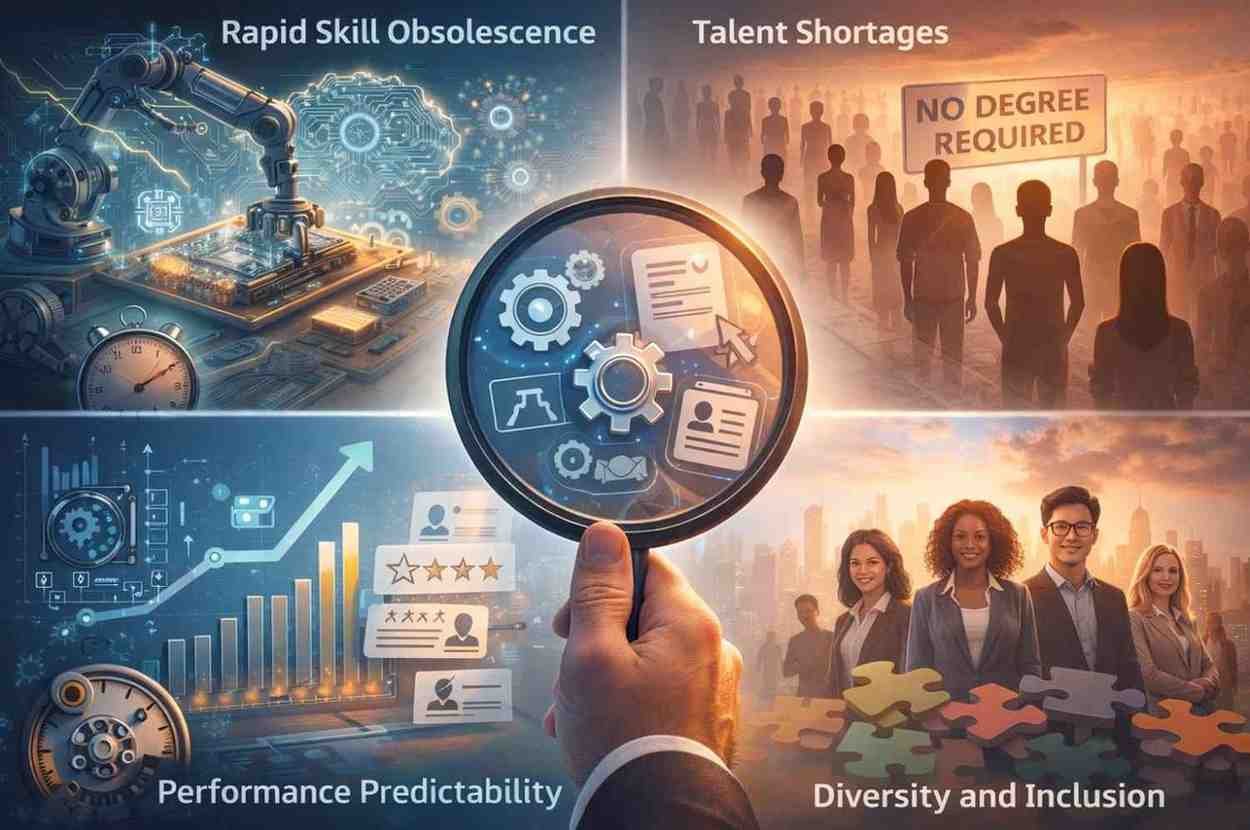
Rapid Skill Obsolescence
Technology cycles move faster than academic curriculum updates. AI, cybersecurity, green energy engineering, and advanced manufacturing require continuous upskilling. Employers need workers who can adapt immediately, not those whose learning is frozen at graduation.
This shift is also encouraging microlearning in 2026, where professionals rely on short, practical modules and even 10-minute lessons to stay current instead of depending solely on traditional study models.
Talent Shortages and Expanded Candidate Pools
Removing degree requirements dramatically expands the candidate pool. LinkedIn Economic Graph research shows that when companies adopt skills-based hiring, the eligible talent pool can expand many times over, in some cases up to 19 times larger.
This includes “STARs” — Skilled Through Alternative Routes — professionals who gained expertise through bootcamps, military service, apprenticeships, or on-the-job training.
Performance Predictability
Research suggests that hiring for specific skills can be significantly more predictive of job performance than hiring based solely on education credentials. Structured skills assessments and work simulations provide measurable indicators of capability.
Diversity and Inclusion Impact
Degree-based filters often disproportionately exclude capable candidates from underrepresented backgrounds. Studies show that eliminating unnecessary degree requirements can significantly increase access to diverse talent, in some cases expanding representation pools by more than 50 percent.
This makes skills-based hiring not only an efficiency strategy but also an equity strategy.
How Skill-Based Learning Is Replacing Degree-Based Hiring in Practice
The transformation is visible across private industry and government.
Major companies such as Google, IBM, Apple, and Tesla have publicly removed degree requirements for many roles, focusing instead on skills assessments and certifications.
In the public sector, more than 20 U.S. governors have committed to eliminating four-year degree requirements for many state government jobs to address labor shortages and improve workforce access.
Meanwhile, job market data indicates that more than half of U.S. tech job postings no longer explicitly require a formal degree. Instead, they emphasize competencies, certifications, and hands-on experience.
Degree-Based Hiring vs Skill-Based Hiring: A Clear Comparison
Below is a structured comparison of the two models:
| Aspect | Degree-Based Hiring | Skill-Based Hiring |
| Primary Filter | Academic degree or university prestige | Demonstrated competencies and certifications |
| Assessment Method | Resume and transcript review | Skills tests, work samples, simulations |
| Learning Path | Multi-year formal education | Bootcamps, micro-credentials, apprenticeships, on-the-job training |
| Performance Signal | Degree level (Bachelor’s, Master’s) | Demonstrated proficiency in high-demand skills |
| Wage Signal | Education level | Skill scarcity and demand |
| Talent Pool | Limited to degree holders | Expanded to alternative-route professionals |
| Diversity Impact | Can unintentionally restrict access | Broadens access to underrepresented groups |
The Rise of the “Skills Premium”

In high-demand sectors like artificial intelligence and advanced analytics, specific technical skills can command wage premiums exceeding 20 percent compared to roles without those competencies.
Employers are increasingly paying for what workers can do, not where they studied. This “skills premium” reflects market demand rather than educational attainment.
In some cases, niche technical skills now influence compensation more strongly than an advanced degree alone.
Challenges Organizations Face
Despite the benefits, implementation is not always smooth.
Many companies face cultural hurdles. Recruiters and hiring managers often default to degree requirements because they are simple screening tools.
Designing rigorous internal skills assessments requires investment. Verifying non-traditional credentials at scale can also be complex.
Harvard Business School research notes that removing degree requirements without redesigning evaluation processes leads to minimal change. True skills-based hiring requires updated job descriptions, standardized rubrics, and interviewer training.
How Employers Can Transition Effectively
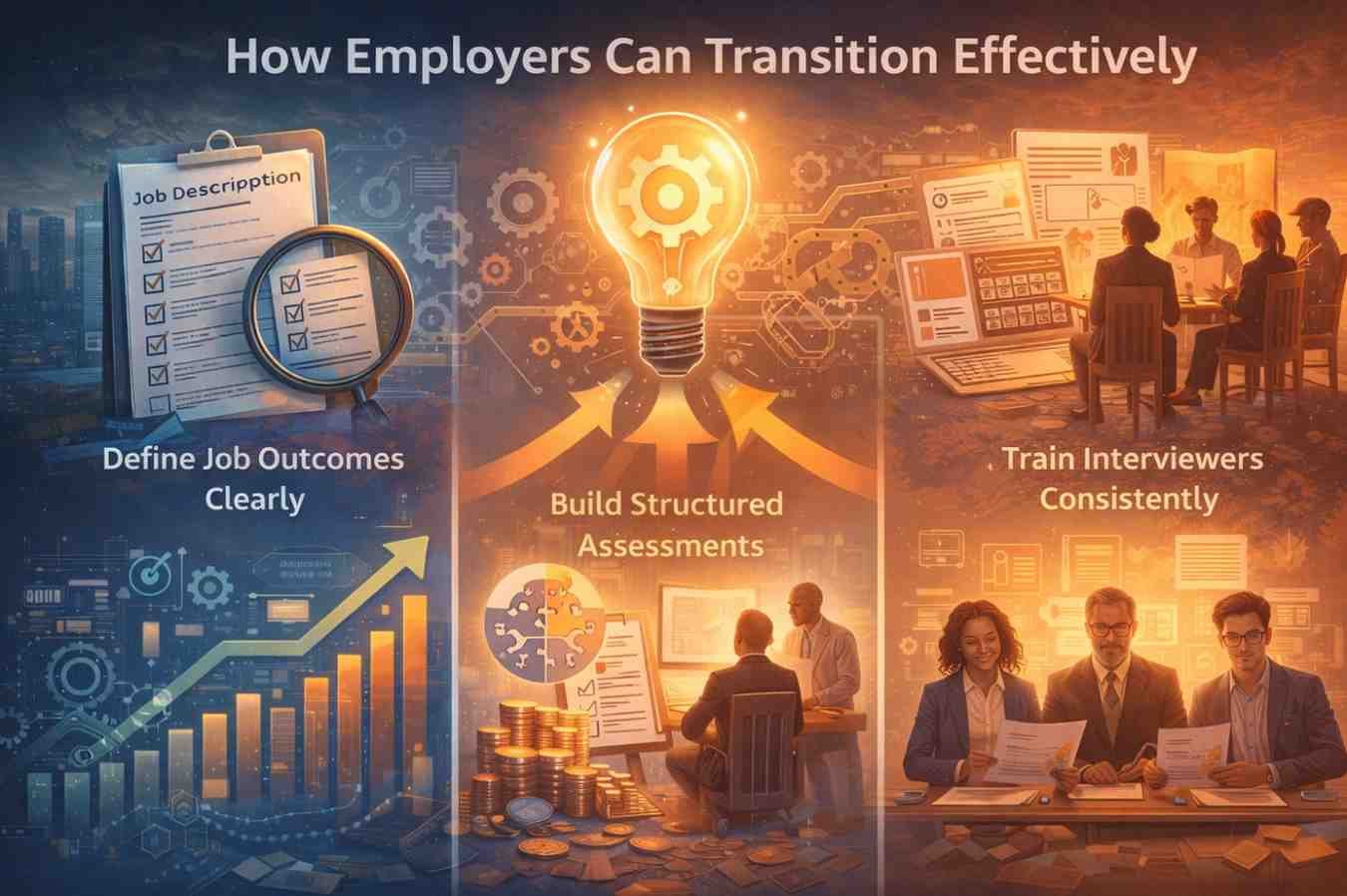
Organizations that succeed typically follow three principles:
- Define job outcomes clearly rather than listing credentials.
- Build structured assessments aligned with real tasks.
- Train interviewers to evaluate skills consistently instead of relying on intuition.
Without process redesign, skill-based hiring remains a slogan rather than a system.
Frequently Asked Questions (FAQs)
1. Is skills-based hiring replacing degrees completely?
No. Degrees remain essential in regulated professions such as medicine, law, and engineering licensure. However, in many corporate and technology roles, demonstrated skills increasingly carry more weight than formal credentials.
2. Why are companies like Google and IBM removing degree requirements?
These companies have found that practical ability and structured skills testing better predict job success. Removing unnecessary degree filters also expands access to untapped talent.
3. Does skill-based hiring improve diversity?
Research suggests that eliminating degree requirements can significantly expand representation among candidates from underrepresented backgrounds, improving both equity and workforce reach.
4. What industries are adopting this model fastest?
Technology, AI, cybersecurity, advanced manufacturing, green energy, and state government roles are leading adoption due to rapid skill evolution and labor shortages.
Conclusion
How Skill-Based Learning Is Replacing Degree-Based Hiring reflects a broader evolution in workforce strategy. Employers are prioritizing measurable capability over academic credentials because technology moves faster than traditional education systems.
This shift is driven by rapid skill obsolescence, labor shortages, performance predictability, diversity goals, and rising skills premiums. While degrees will not disappear, they are no longer the primary gatekeeper in many industries.
The future of hiring belongs to organizations that can clearly define, measure, and reward real-world competence.