

I still remember the night I seriously searched how to start a tech startup. I had a notebook full of ideas, a half-built website, and exactly zero paying customers. I thought I needed a flashy pitch deck and a clever logo. What I actually needed was validation, discipline, and a team that could execute.
If you are wondering how to start a tech startup today, the answer is not about chasing a million-dollar idea. It is about solving a painful problem, testing it fast, and building something people genuinely want. Nearly 90 percent of startups fail, and most fail because they build products nobody asked for. Let us make sure you are not one of them.
Why Is How to Start a Tech Startup About Validation First?
When people ask how to start a tech startup, they usually think about product features or funding.
Start With a Painful Problem
The real starting point is validation. Do not begin with a solution. Begin with a problem that genuinely frustrates people enough to pay for relief. List issues that annoy you or your peers. Focus on outdated systems, inefficient tools, or repetitive tasks that waste time or money.
Validate Through Real Conversations
Before building anything, talk to potential users. Ask what they use now, what they dislike, and what feels broken. If they are not frustrated enough to pay for a better option, the opportunity is weak.
Run a Simple Smoke Test
Create a basic landing page explaining your idea. Drive targeted traffic and track signups. If people share their email for a product that does not yet exist, you have real interest.
How to Start a Tech Startup by Forming the Right Founding Team
You can begin with:

Build Two Core Pillars
Understanding how to start a tech startup means accepting you cannot do it alone. Most strong startups begin with two pillars. One founder drives vision, sales, and growth. The other builds and maintains the product. Clear role division prevents chaos later.
Bring Complementary Strength
If you are not technical, you must contribute serious value in marketing, operations, or deep industry knowledge. A strong technical cofounder joins for impact and alignment, not excitement alone. Your skills must balance each other.
Prioritize Culture and Early Hires
Cultural fit matters more than raw talent. Early hires shape long term culture. Look for adaptable, resilient people who can handle uncertainty. Platforms like LinkedIn, Techstars, Startup Grind, and niche communities are great places to start.
How to Start a Tech Startup with a Focused MVP?
If you truly want to master how to start a tech startup, learn the art of the MVP. Your Minimum Viable Product is the simplest version of your solution that solves the core problem. It is not your dream product. It is your test. Iterative development is critical. Build quickly, release early, and gather feedback. Do not wait until everything looks perfect. Perfection delays learning.
The 80 20 rule applies strongly here. Eighty percent of results often come from twenty percent of features. Identify that critical twenty percent and build only that. Every extra feature you add too early slows you down and increases risk. In 2025, you can use no code tools, AI assisted coding platforms, and cloud services to launch quickly. Speed of learning matters more than beauty.
How to Start a Tech Startup with Strong Legal and Business Foundations?
A practical guide on how to start a tech startup must include the boring but essential foundations.

Choose the Right Structure Early
Ignoring structure can cause serious disputes later. Most tech startups form a C corporation if they plan to raise venture capital because investors prefer predictable equity structures. If you are bootstrapping, an LLC may offer more flexibility in the early stage. Choose based on your long-term funding goals.
Set Up Smart and Protect Your IP
Use incorporation tools like Stripe Atlas to streamline formation, banking, and key documents. Protect your intellectual property from day one. Make sure cofounder and employee agreements clearly assign IP to the company, and register trademarks if your brand is central to your growth.
How to Start a Tech Startup and Secure Funding the Right Way?
Many founders think funding is the first milestone in how to start a tech startup. It is not.
Funding Is Fuel, Not Validation
Many founders assume funding is the first big step in how to start a tech startup. It is not. Funding supports growth, but it does not prove demand. Validation comes from real users, not investor checks.
Start With Bootstrapping
If possible, begin by bootstrapping. Use personal savings, early revenue, or consulting income to build your MVP. This keeps you focused on customers instead of chasing capital too soon.
Raise Smart, Not Fast
Pre seed funding often comes from friends, family, or angel investors who believe in you. Your pitch deck should clearly show the problem, solution, market size, traction, and your team’s edge. Apply to accelerators like Y Combinator only when you show real momentum.
How to Start a Tech Startup Step by Step
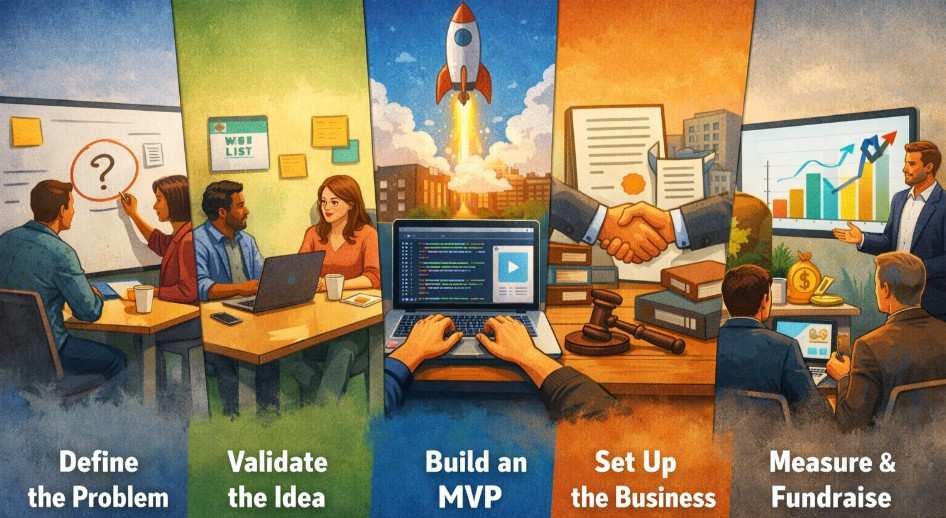
- First, define the problem in one clear sentence. If you cannot explain it simply, you do not understand it well enough yet.
- Second, validate through conversations and smoke testing. Gather evidence that people care deeply about the issue.
- Third, build a lean MVP focused only on the core functionality. Launch to early adopters and track real behavior, not compliments.
- Fourth, formalize your company with the appropriate legal structure and proper documentation. Protect intellectual property and clarify equity splits early.
- Fifth, analyze traction before pursuing funding. If users return consistently and show willingness to pay, then prepare your pitch and approach investors strategically.
Each step builds logically on the previous one. Skipping steps increases risk dramatically.
Frequently Asked Questions
1. How much money do I need when learning how to start a tech startup?
The required capital varies widely. Many software startups launch with under ten thousand dollars using cloud tools and no code platforms. Hardware or deep tech ventures may require significantly more. Start lean and validate before spending heavily. Focus on proving demand first. Investors care about traction and clarity more than early polish.
2. Do I need a technical background to understand how to start a tech startup?
You do not need to code, but you must understand product fundamentals. If you lack technical skills, partner with someone who has them. Your value must come from business strategy, industry insight, or customer acquisition strength. Even non technical founders should understand product workflows and technical constraints to communicate effectively.
3. How long does it take to succeed after learning how to start a tech startup?
There is no universal timeline. An MVP can be built in weeks, but finding product market fit often takes months or years. Consistent iteration and user feedback accelerate progress. The key is not rushing blindly but learning quickly from real data.
4. Is it too late in 2025 to learn how to start a tech startup?
Absolutely not. Every year brings new technological shifts. AI, climate innovation, fintech, cybersecurity, and health technology continue evolving. New problems constantly emerge as technology changes. Opportunity favors founders who focus on solving real pain points better than existing tools.
How to Start a Tech Startup
If you truly understand how to start a tech startup, you realize it is not about hype. It is about disciplined execution, relentless validation, and building a team capable of turning vision into scalable reality. Ideas are cheap. Execution is everything. Start with a painful problem. Validate it thoroughly. Build lean. Protect your foundations. Fund wisely.
My biggest lesson is this. Fall in love with solving problems, not chasing status. If you stay focused on value and learning speed, you give yourself a real chance to beat the statistics and build something meaningful.