I used to think “real studying” meant blocking off big chunks of time, sitting down with a textbook, and grinding through chapters. But in 2026, that approach fights the way most of us actually live and work. Our calendars fill up. Notifications compete for attention. Skills change faster than syllabi.
That is why microlearning (also called bite-sized learning or nano learning) keeps winning mindshare: short, focused lessons you can finish in 5–10 minutes, usually on mobile, often inside an LMS or learning experience platform (LXP).
So here’s the honest question: can 10-minute lessons replace traditional study?
In most cases, microlearning can replace big parts of traditional study. It cannot replace all of it. The “winner” depends on the outcome you want: fast performance, long-term mastery, or deep conceptual understanding.
Let’s break it down in a practical way.
What is microlearning in 2026, and why does it feel everywhere?
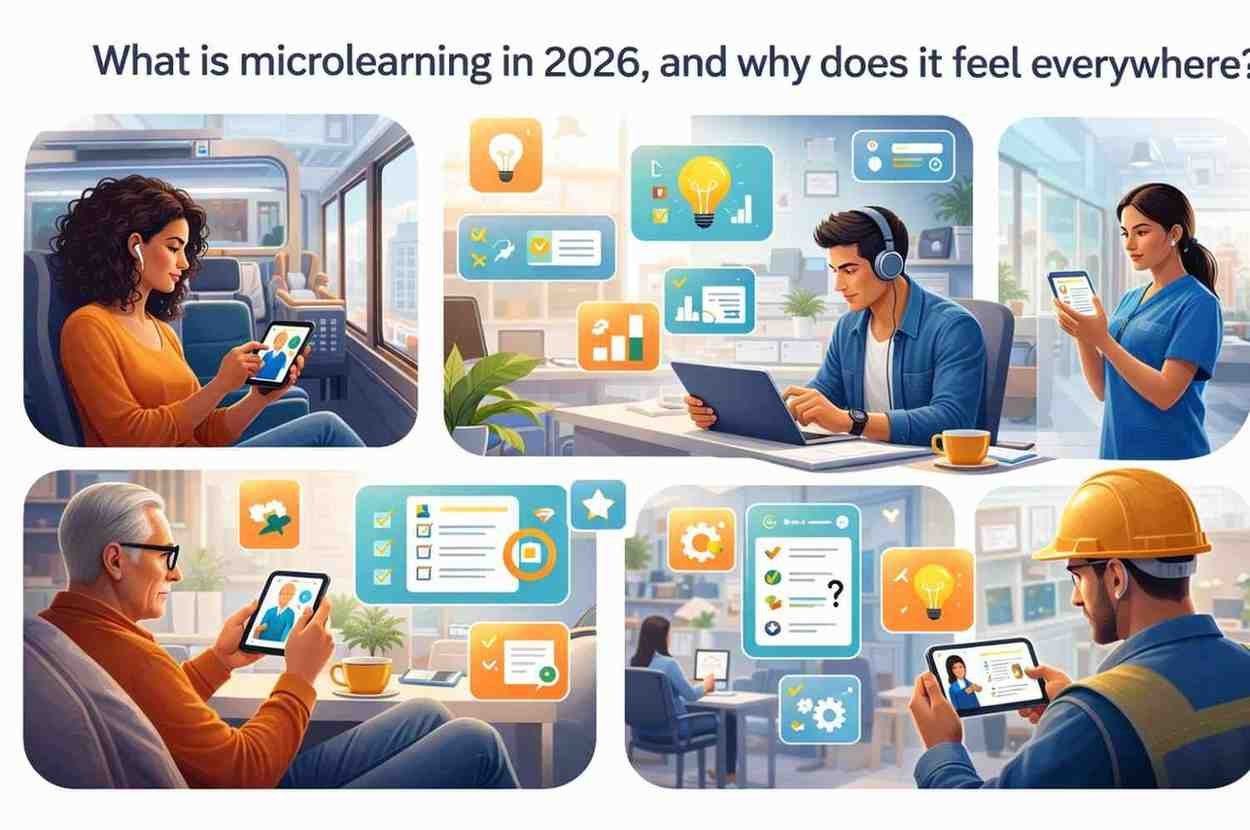
Microlearning in 2026 is not just “short videos.” The best programs use learning science on purpose: one objective per lesson, active recall, quick practice, and repetition over time. Think of it as structured, just-in-time learning that fits into a real day.
Instead of “Study Chapter 7,” the lesson becomes “Explain X concept in one minute,” or “Solve one problem type,” or “Practice one workflow step.” It reduces cognitive load by chunking content into minimal meaningful units.
That design makes microlearning perfect for:
- upskilling and reskilling in fast-moving industries
- corporate training and compliance refreshers
- software training, process changes, and onboarding
- exam review and retention practice (not first exposure)
Can 10-minute lessons actually replace traditional study?
Yes, but only when the job-to-be-done matches the format.
Microlearning can replace traditional study when you need:
- quick understanding and immediate application
- repetition for long-term retention
- behavior change through habit-building
- performance support at the moment of need
Traditional study still wins when you need:
- deep mental models and connected understanding
- long-form reading, synthesis, and argument building
- guided feedback, mentorship, or lab-style practice
- credential-focused learning where assessment demands depth
If you’ve ever tried to learn something complex (data structures, accounting, anatomy, a new language beyond beginner level), you already know the truth: you can’t build advanced skill purely from fragments. You need longer sessions sometimes to connect concepts.
So the real answer is: microlearning replaces the “bulk time” strategy, not the “depth” strategy.
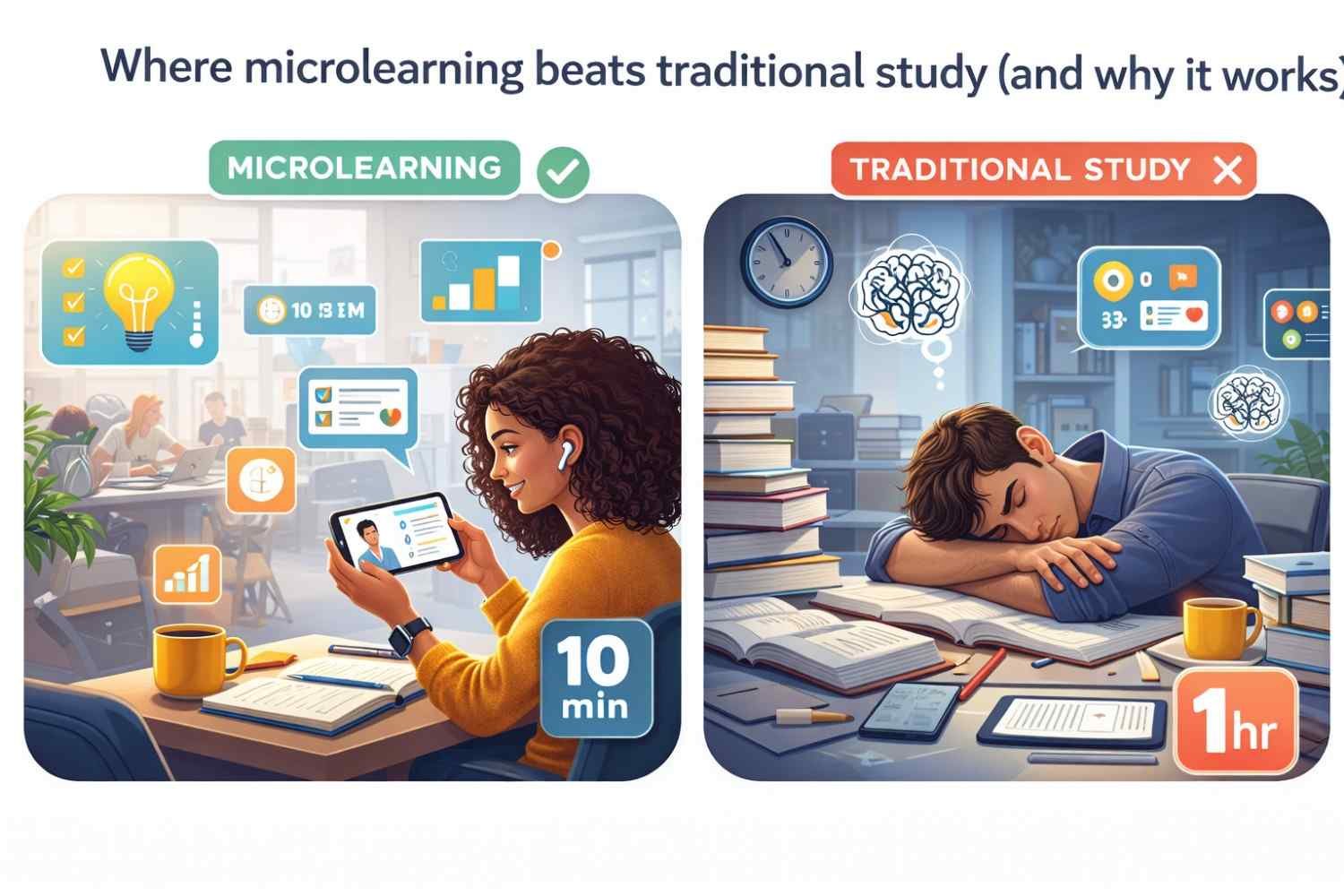
Where microlearning beats traditional study (and why it works)
It fits how memory actually forms
If you want lasting learning, you need spaced repetition and retrieval practice. Microlearning makes that easy because it naturally creates frequent touchpoints. You learn, recall, and re-apply in short bursts across days instead of cramming once.
Traditional study often turns into massed practice: long sessions packed together. That can feel productive, but it fades faster.
It reduces overwhelm and increases consistency
People don’t fail because they’re lazy. They fail because the plan requires heroic effort. Ten minutes lowers the “starting friction,” which is why microlearning supports habit formation so well.
In my own routine, the biggest win isn’t the lesson. It’s the streak. Consistency compounds.
It supports “flow of work” learning
In modern workplaces, the best learning happens close to the task: a 7-minute module before a meeting, a quick scenario before handling a customer escalation, or a short simulation before touching a live system. That is just-in-time learning at its best.
Where microlearning fails (and what competitors often don’t explain)
A lot of competitor content sells microlearning like it’s magic. The weaknesses matter, because they explain why some microlearning programs flop.
Microlearning fails when it becomes “content confetti”
Too many micro-lessons with no path creates noise. Learners finish modules but don’t build a mental model. Without sequencing, microlearning can turn into random tips that never become skill.
Microlearning fails when it skips practice
Watching a 10-minute lesson feels productive. But skills grow through doing. If there is no quiz, scenario, active recall prompt, or real task application, the lesson becomes passive content.
Microlearning fails when the topic requires deep integration
Some subjects need longer focus blocks: writing an essay, solving multi-step proofs, building a full app, learning clinical judgment, or mastering advanced math. Microlearning can support these goals, but it can’t fully replace longer deliberate practice.
What should replace traditional study in 2026? A smarter hybrid
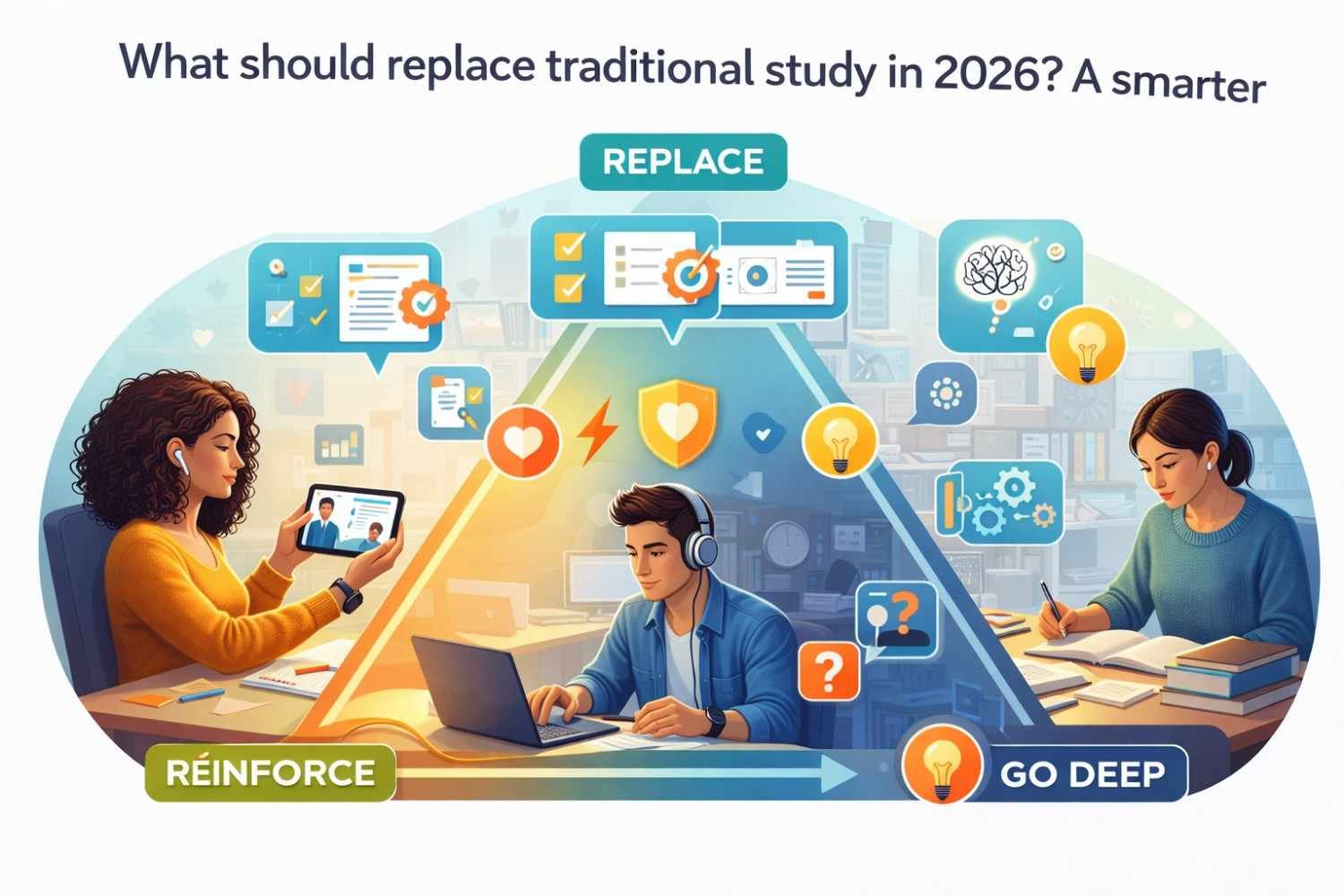
If you want the best outcomes, use this simple model:
Replace
Use microlearning instead of long sessions for:
- refreshers, review, reminders
- process steps and tool workflows
- compliance and policy updates
- flashcard-style concepts and definitions
Reinforce
Use microlearning to reinforce deeper learning:
- daily retrieval questions after a course
- spaced repetition schedules
- quick scenario prompts to strengthen transfer
Go deep
Use traditional study blocks for:
- complex new topics
- synthesis, projects, and writing
- building frameworks, not facts
- coached feedback and long practice
This is the gap most competitors miss: microlearning is strongest as a system, not a pile of short lessons. The same principle shows up in many proven tips for lifelong learning that actually work — progress comes from building repeatable systems that compound over time, not from isolated bursts of effort.
How do you build a microlearning study plan that actually works?
Here’s a realistic microlearning routine I recommend (and use myself when I’m learning something technical):
Step 1: Pick one outcome, not one topic
Instead of “learn cybersecurity,” choose “I can explain phishing defenses and apply them in my inbox.”
Clear outcomes prevent shallow learning.
Step 2: Design each lesson around active recall
Each 10-minute lesson should include:
- a 60-second explanation or example
- 2–4 retrieval questions (no notes)
- one tiny application task
This turns learning into memory building.
Step 3: Use spaced repetition on purpose
Repeat key ideas over time. A simple pattern:
- Day 1: learn + test
- Day 3: quick quiz
- Day 7: scenario
- Day 14: mixed review (interleaving)
Step 4: Add one weekly deep session
Once a week, schedule 45–90 minutes for:
- connecting concepts
- building a project
- writing a summary in your own words
- doing harder mixed practice
Microlearning keeps the engine running. The deep session builds the structure.
Microlearning vs Traditional Study: The 2026 Reality
Traditional study:
- Builds foundational knowledge
- Supports complex reasoning
- Enables mastery in demanding fields
- Requires long attention spans
Microlearning:
- Increases retention by 25% to 60%
- Is 300% faster to develop
- Achieves 83% completion rates
- Supports continuous learning
- Integrates into daily workflow
- Aligns with cognitive science
The question is not which one wins.
The question is how you combine them.
Frequently Asked Questions (FAQs)
1. Can microlearning replace college or certification programs?
Microlearning can replace parts of the learning process (review, practice, reinforcement), but formal programs still require depth, guided progression, and high-stakes assessment preparation. The best approach uses microlearning between longer learning sessions.
2. Is microlearning effective for students or only corporate training?
It works for both. Students benefit most when microlearning supports active recall, spaced repetition, and exam review. Corporate training benefits when lessons map to real workflows and role-based skills.
3. What is the ideal length for a microlearning lesson?
In practice, 5–10 minutes works well for a single objective. But the real rule is: stop when attention drops and before cognitive load spikes. Shorter is not always better if you remove practice.
4. What tools support microlearning best in 2026?
Look for LMS or LXP tools that support mobile learning, short assessments, spaced repetition, analytics, and personalized learning paths. The platform matters less than the design, but good delivery improves completion and retention.
So, can 10-minute lessons replace traditional study in 2026?
They can replace the old assumption that “more time equals better learning.” They can replace cramming. They can replace huge, exhausting study blocks for a lot of real-world learning goals.
But they won’t replace deep work when the skill demands depth.
In 2026, the smartest learners don’t choose sides. They build a system: microlearning for momentum and memory, plus longer sessions for mastery and meaning.